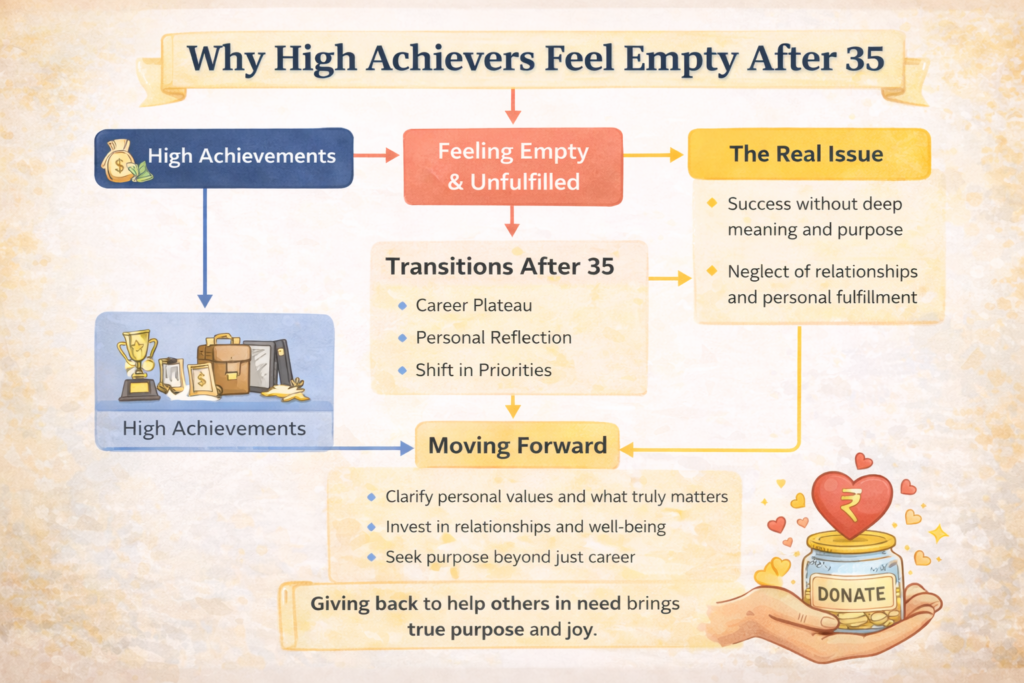
By the age of 35, many high achievers have checked most of the boxes.
A stable career.
Financial growth.
Respect in society.
Comfortable lifestyle.
Responsibilities handled.
From the outside, life looks successful.
But inside, something feels… different.
Not failure.
Not crisis.
Just a quiet emptiness.
A question that slowly grows louder:
“Why doesn’t this feel enough anymore?”
The First Phase: Achievement Mode
In our 20s and early 30s, life is driven by ambition.
We want to prove ourselves.
We want growth.
We want recognition.
We want financial security.
This phase is exciting. Fast. Competitive.
Goals are clear:
- Earn more
- Get promoted
- Build something
- Move ahead
And when progress happens, it feels rewarding.
But achievement has a hidden limitation.
It is external.
It depends on titles, income, validation, comparison.
And external rewards eventually stop filling internal needs.
The Midpoint Shift
Around 35, something shifts.
You are no longer chasing survival.
You are no longer proving your worth.
You have already achieved enough to know you can.
And suddenly, the race feels repetitive.
Another raise.
Another upgrade.
Another milestone.
But the emotional impact is smaller each time.
What once felt thrilling now feels routine.
This is not failure.
It is evolution.
Success Without Meaning Feels Incomplete
High achievers are disciplined. Focused. Capable.
But many have spent years building careers — not necessarily building meaning.
Work becomes routine.
Money becomes normal.
Lifestyle becomes stable.
And then comes the deeper human need:
Purpose.
We are not designed only to earn.
We are designed to contribute.
When contribution is missing, emptiness appears.
The Psychological Truth
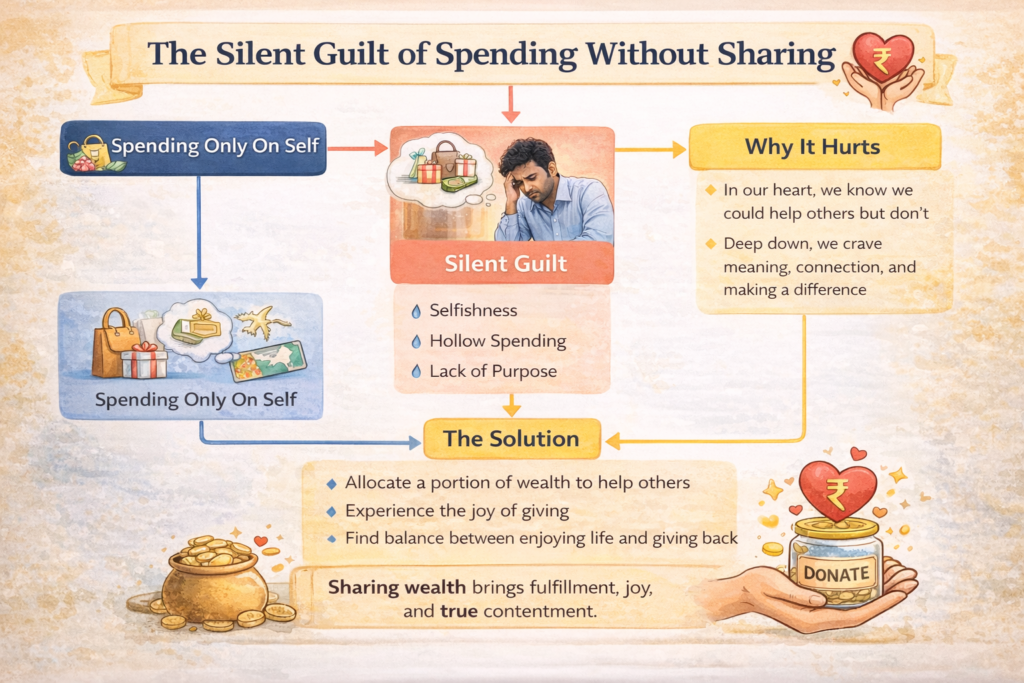
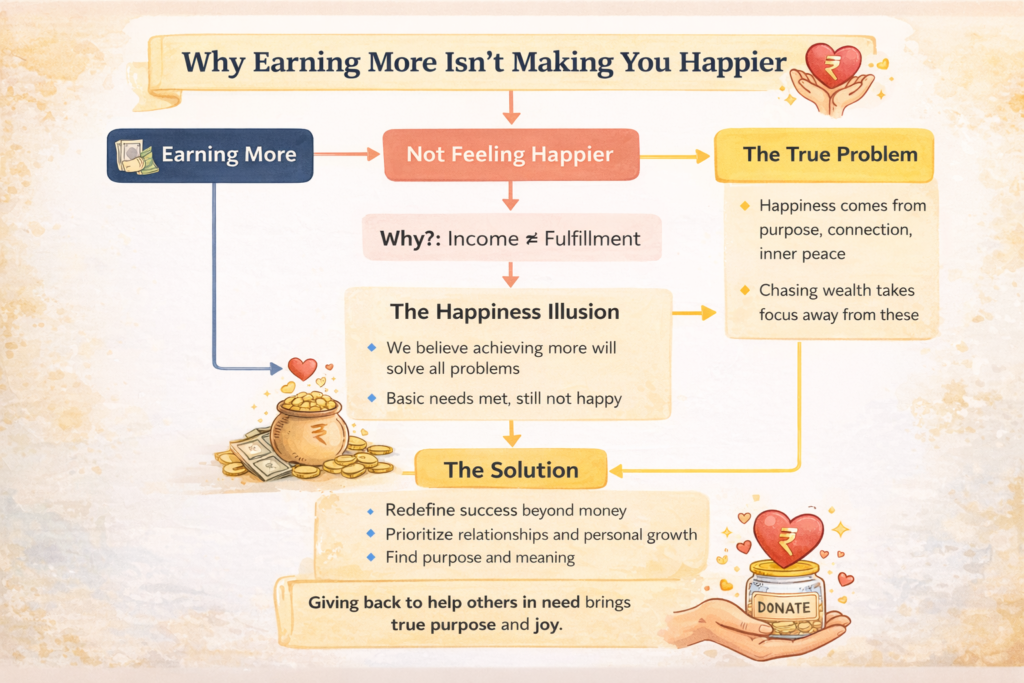
Research shows that after a certain income level, happiness does not rise significantly with more money.
Why?
Because basic needs are already met.
After that, fulfillment comes from:
- Impact
- Relationships
- Contribution
- Alignment with values
Without these, success feels shallow.
High achievers often reach a stage where they realize:
“I have built a life. But what is it built for?”
The Desire to Matter
At 35 and beyond, people begin to think long-term.
Legacy replaces competition.
Impact replaces comparison.
Depth replaces speed.
There is a natural desire to matter in a way that outlasts income.
Not just to grow wealth — but to create change.
This is not midlife crisis.
It is maturity.
Why Contribution Changes Everything
When success starts serving something beyond the self, fulfillment returns.
Using your resources — time, influence, or financial capacity — to uplift others creates a different emotional response.
It feels grounding.
It feels real.
It feels aligned.
Especially when that contribution supports education.
Because education is not a temporary relief — it is a long-term transformation.
When a child continues her education, you don’t just help today.
You alter her future.
And being part of that shift brings a deeper kind of satisfaction.
From Accumulation to Alignment
High achievers don’t stop achieving after 35.
They simply redefine success.
Earlier, success meant:
“How far can I go?”
Later, it becomes:
“How far can I help others go?”
This shift brings peace.
Because now growth has direction.
Now earnings have meaning.
Now progress has purpose.
Filling the Inner Gap
The emptiness many feel is not a lack of achievement.
It is a lack of alignment.
When lifestyle grows but impact does not, the inner space feels hollow.
But when prosperity supports possibility for someone else, that hollow space fills.
You begin to feel:
“My success stands for something.”
And that feeling is powerful.
It is steady.
It is quiet.
It lasts longer than applause.
A More Complete Definition of Achievement
Perhaps the real achievement after 35 is not another milestone.
Perhaps it is integration.
Where your ambition and your compassion coexist.
Where your growth uplifts others.
Where your earnings educate someone.
Where your success extends beyond your own life.
That is when achievement transforms into meaning.
And meaning dissolves emptiness.